For overloaded SLPs — you stay in control
You may not be able to reduce your caseload, but you CAN reduce your workload with EASI.
EASI helps with the clinical paperwork that fills your evenings: therapy notes, session planning, therapy plans and activities, progress reports, and IEP goal progress — plus MySLP, a speech‑language assistant for quick answers. It’s the work you already do, with you reviewing and approving everything.
Nothing new to learn. You make the call.
Familiar clinical work, organized the way SLPs think. EASI prepares drafts; you review, edit, and approve before anything leaves EASI.
Individual access: $39/month or $199/year. Team of 10+? Ask about group pricing.
No case needed to startYou approve everythingStudents & university clinics welcome


Same caseload. Less paperwork. Your evening back.
Notes, plans, and progress reports take less of your time, and you stay the final authority.
Everyday help for the work that piles up
Notes, summaries, session plans, therapy activities, progress reports, and IEP goal progress, with reports and evaluations right there when you need them. You stay in charge of the clinical decisions.

How the workflow looks
Real product UI from the live system.
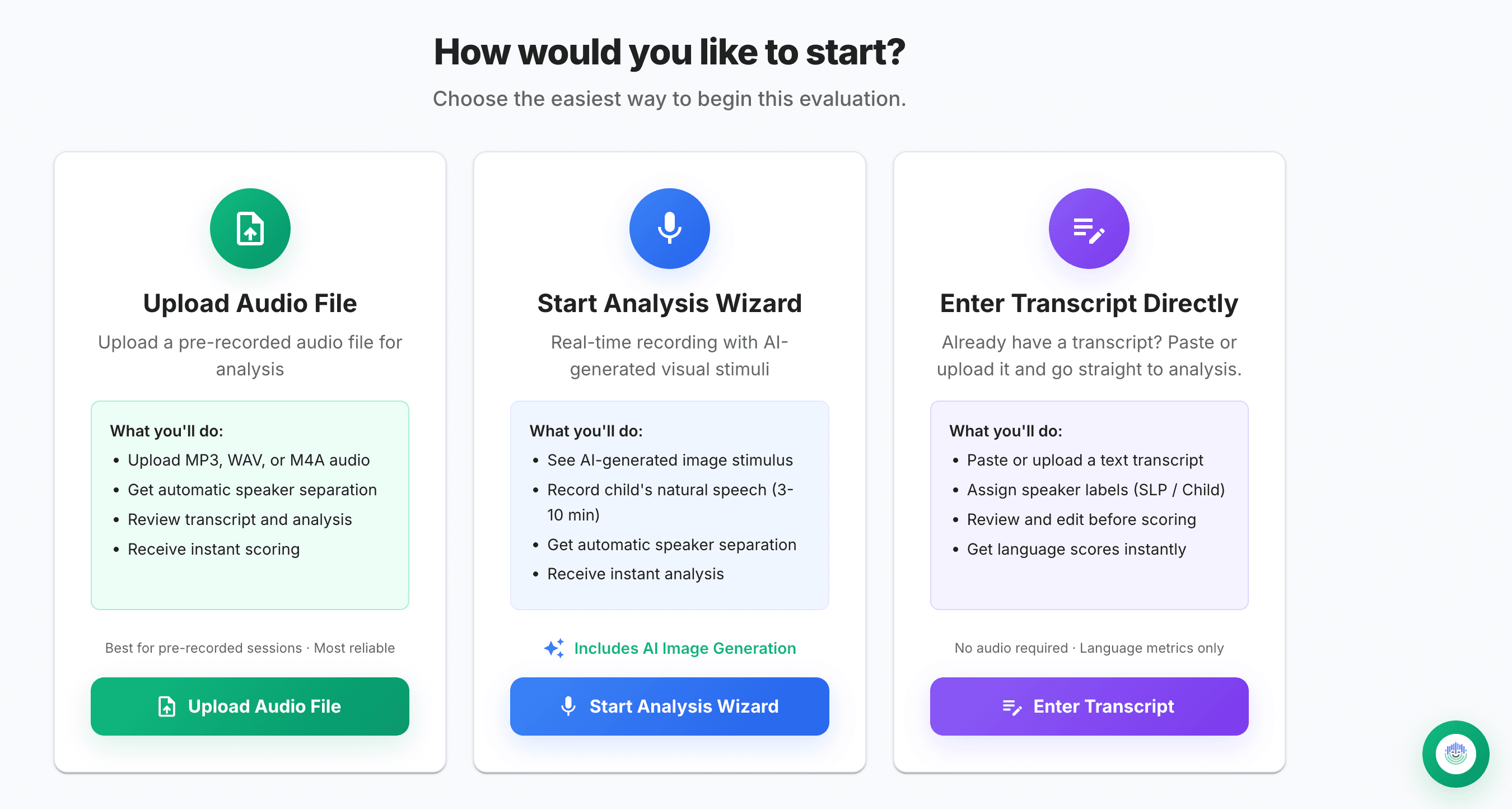
Get the speech sample
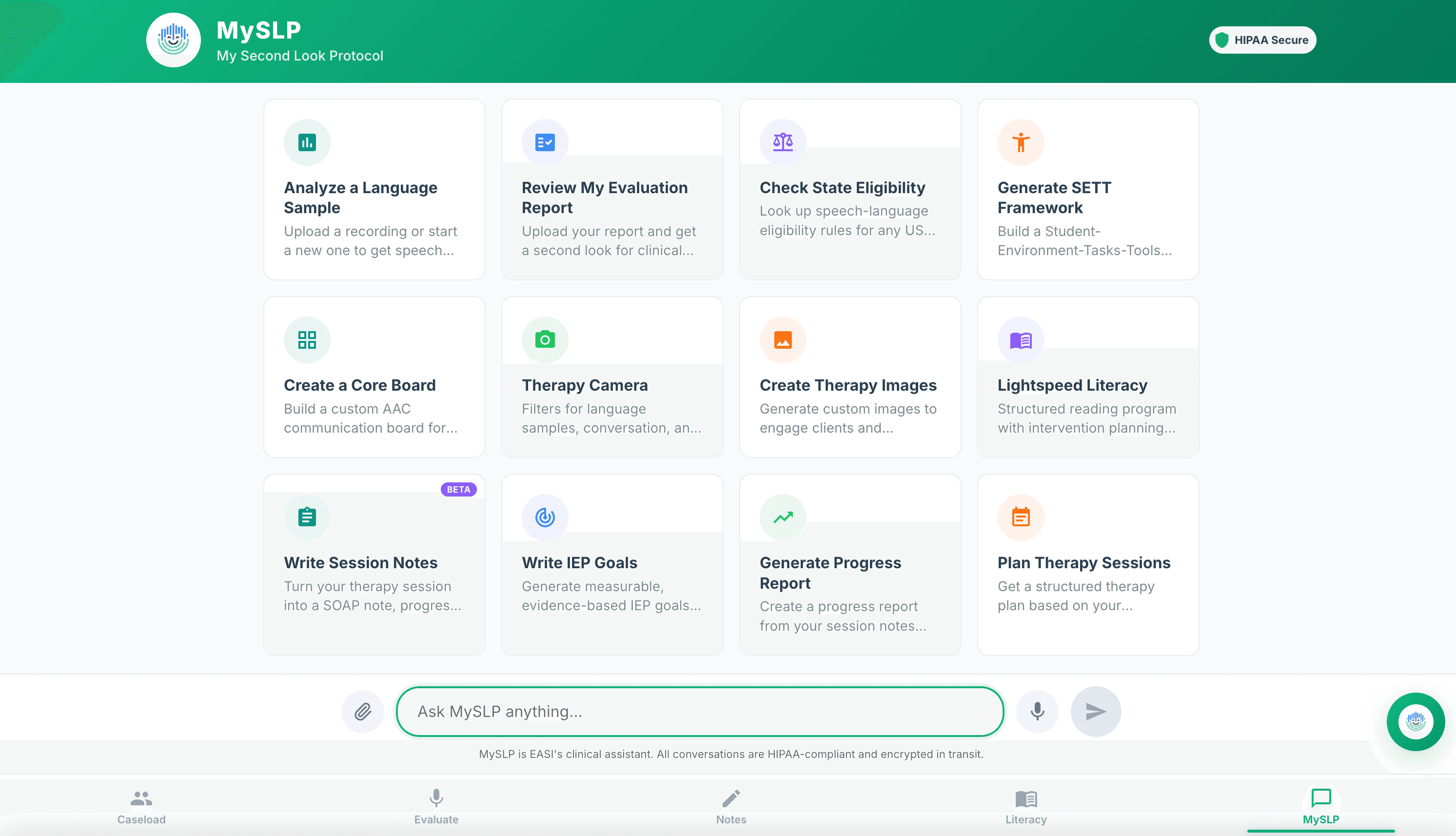
MySLP assistant

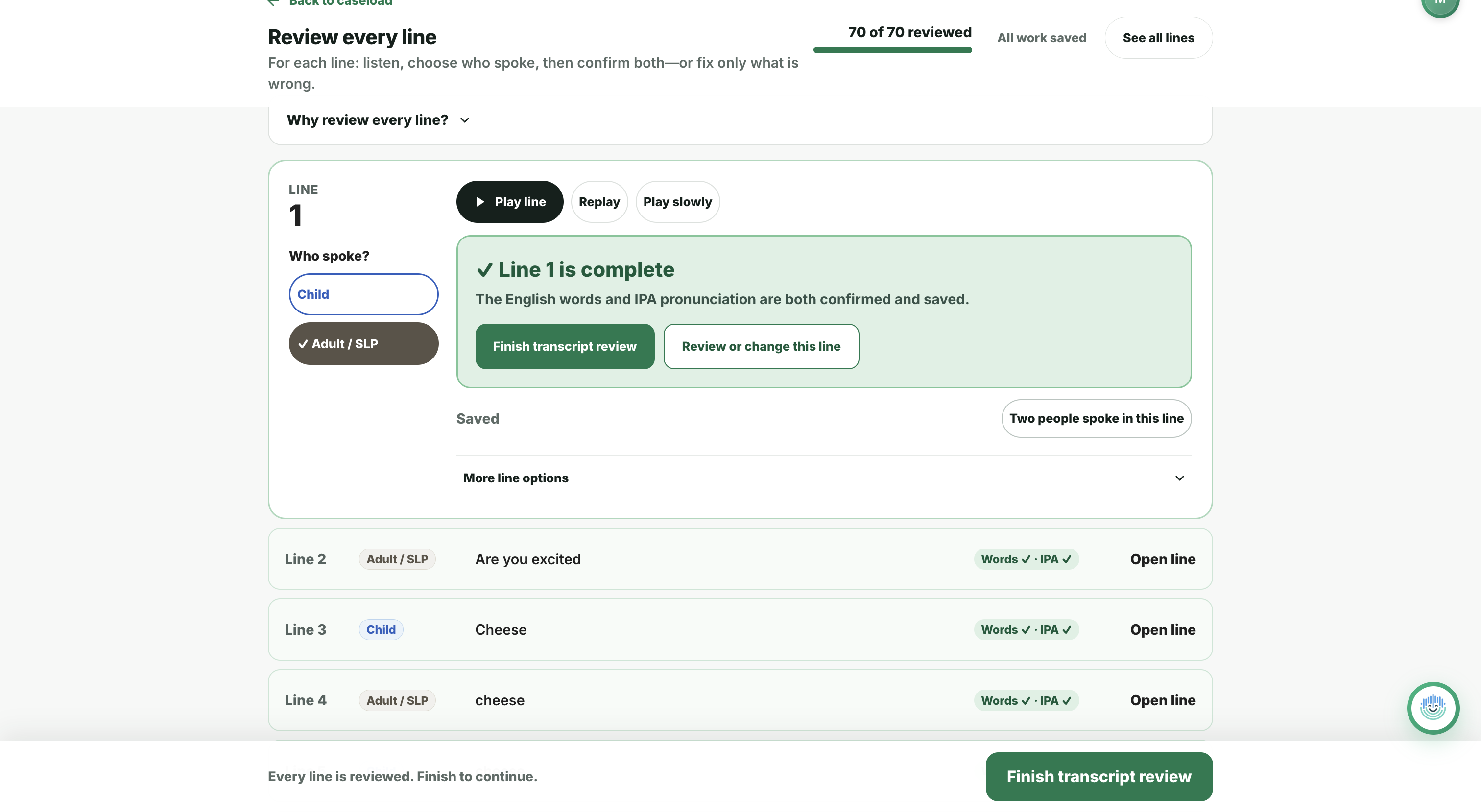
Transcript review — confirm every line
Review who spoke and confirm words + IPA before any scores.
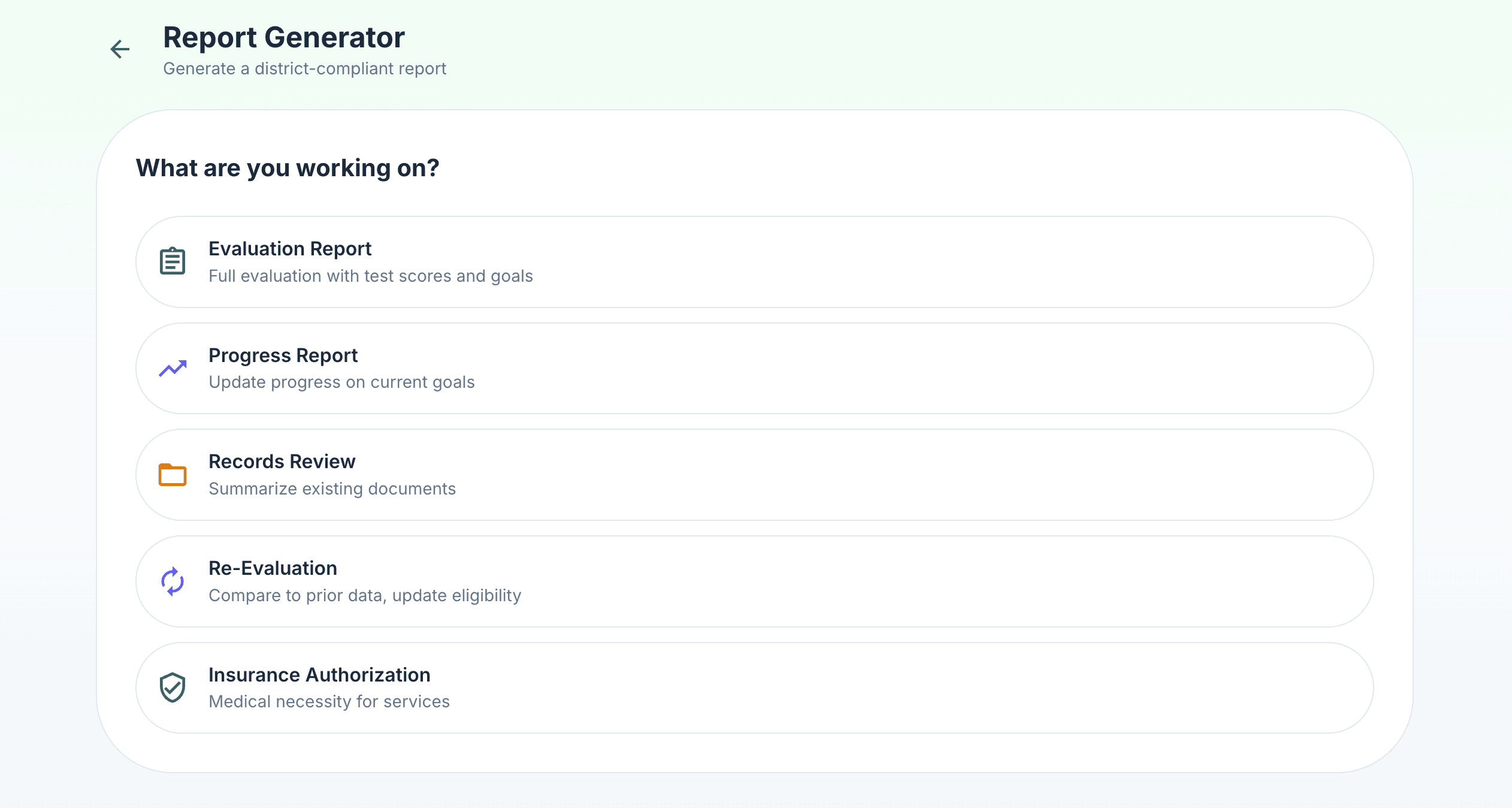
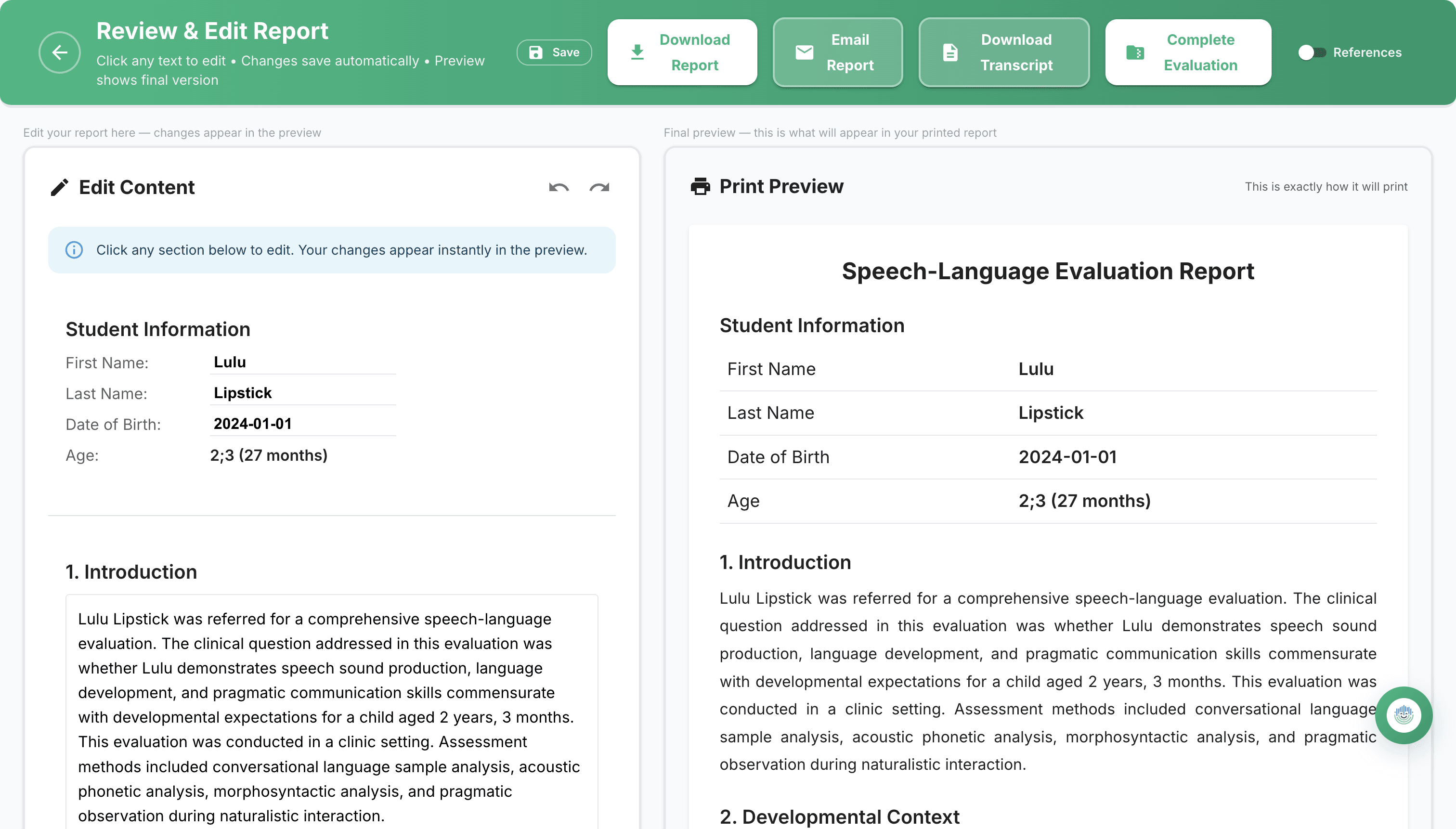
Report generator — choose your template
Notes / SOAP
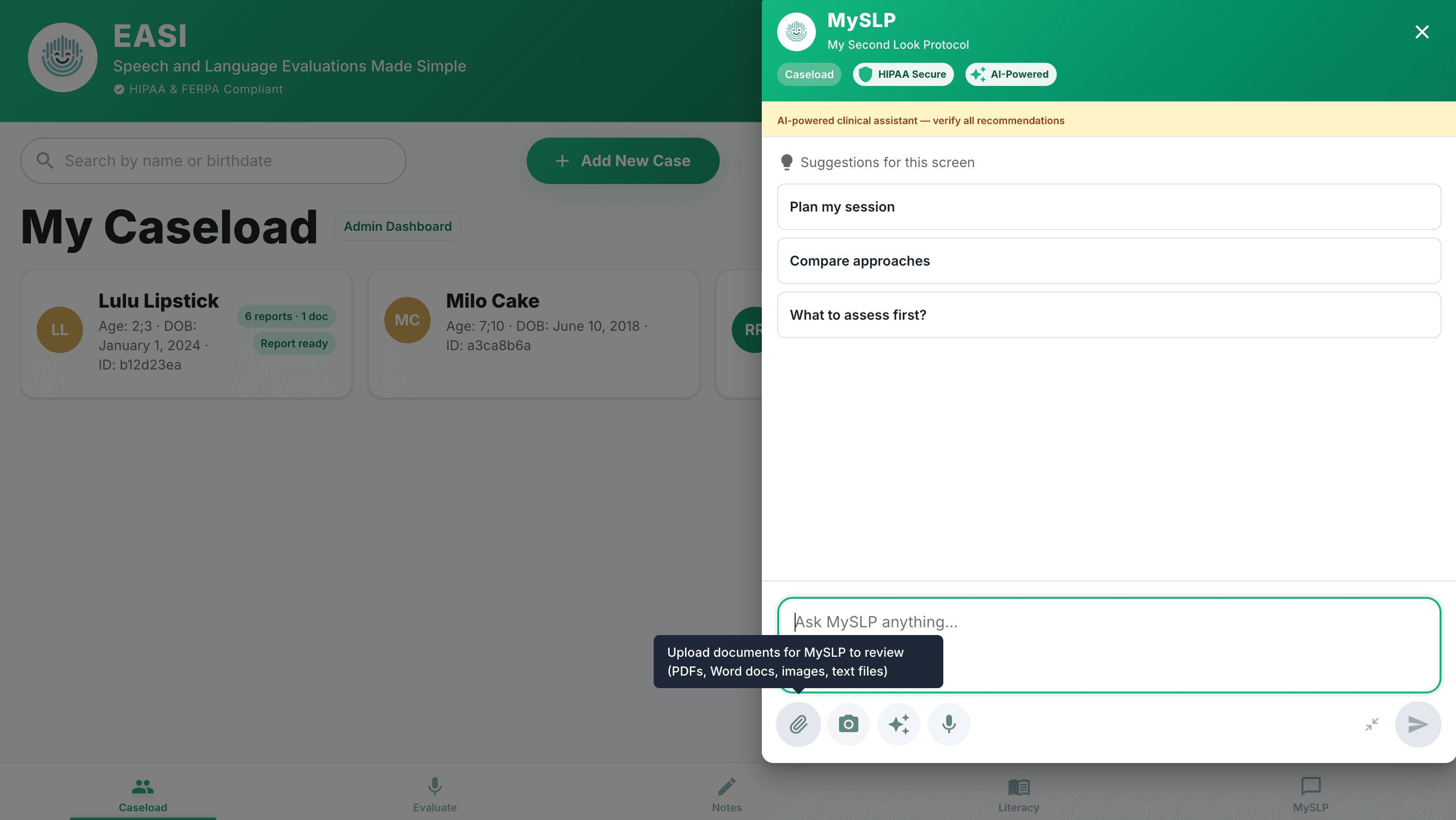
Caseload & case profile
Context stays with the student—so downstream notes and reports stay fair.
Keep canonical facts—age, languages, dialect/ethnicity, and relevant medical history—with the case. EASI carries that context into analysis, notes, and reports so the clinician doesn’t accidentally pathologize dialect or L2 influence.
- One workspace per student across evaluations, therapy, progress, and planning
- Goals and dated evidence remain linked to the profile
- Nothing auto‑publishes—every draft is clinician‑editable
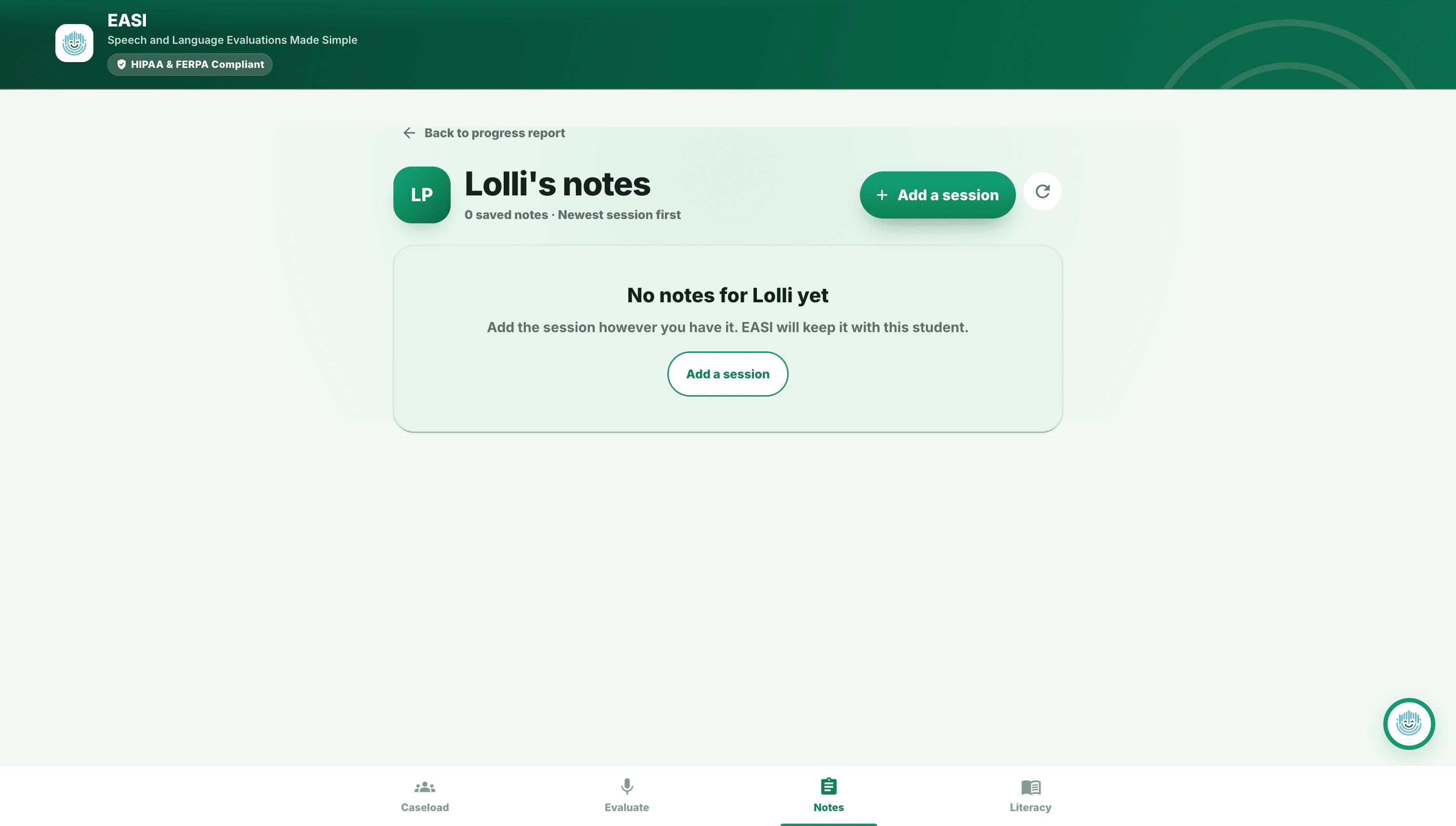
Therapy notes & progress
Progress reports straight from your session notes.
Write a progress report from your session notes or past documentation, with no analysis required. For complex or legal cases, a progress report can draw on many language samples (30, for example), which would be impractical by hand. You review and edit before anything leaves EASI.
- Dictated, typed, or photographed handwritten notes
- Goals linked to session notes for progress reporting
- SOAP drafts for clinician review—not auto‑published
- Many language samples in one report for complex or legal cases
- Copy/paste to your EMR when needed
MySLP — try it, no case needed
An assistant that only talks speech‑language.
Plan a 30‑minute session around the student’s goals, generate a data sheet, suggest the next goal from a report, create a printable core board with speech output, use the SETT framework for AAC, prepare parent strategies, and generate therapy images. If a word list is required, it asks rather than fabricates targets.
MySLP draws on a curated speech‑language knowledge base: differential diagnosis, study help, and course or training content. It politely declines off‑topic questions. Students and university clinics use it for coursework and clinic.
- • Session planner, data sheets, and measurable goal suggestions
- • Core boards, home programs, and image generation
- • SETT framework prompts for Student / Environment / Tasks / Tools
- • Differential diagnosis and study help for students and clinics
Language sample & transcript review
Record or upload, then verify who said what before any scores.
Start with a recording or upload audio. Speaker split (adult vs child). Play each line to verify. The clinician fixes overlaps and can view IPA. Only child utterances are scored; adult talk is kept as context, not analyzed as the client. Human verification comes first.
Reports
Editable drafts with sign‑gates—not auto‑published documents.
Small samples refuse NDW/IPSyn rather than invent them. Sign‑gates warn when conclusions outrun the evidence. Available metrics include MLU, PCC (SD from mean), percent delay (used in CA EI), and IPSyn. Generate measurable IEP goals from the report, then edit on the left and preview on the right before signing.
Literacy
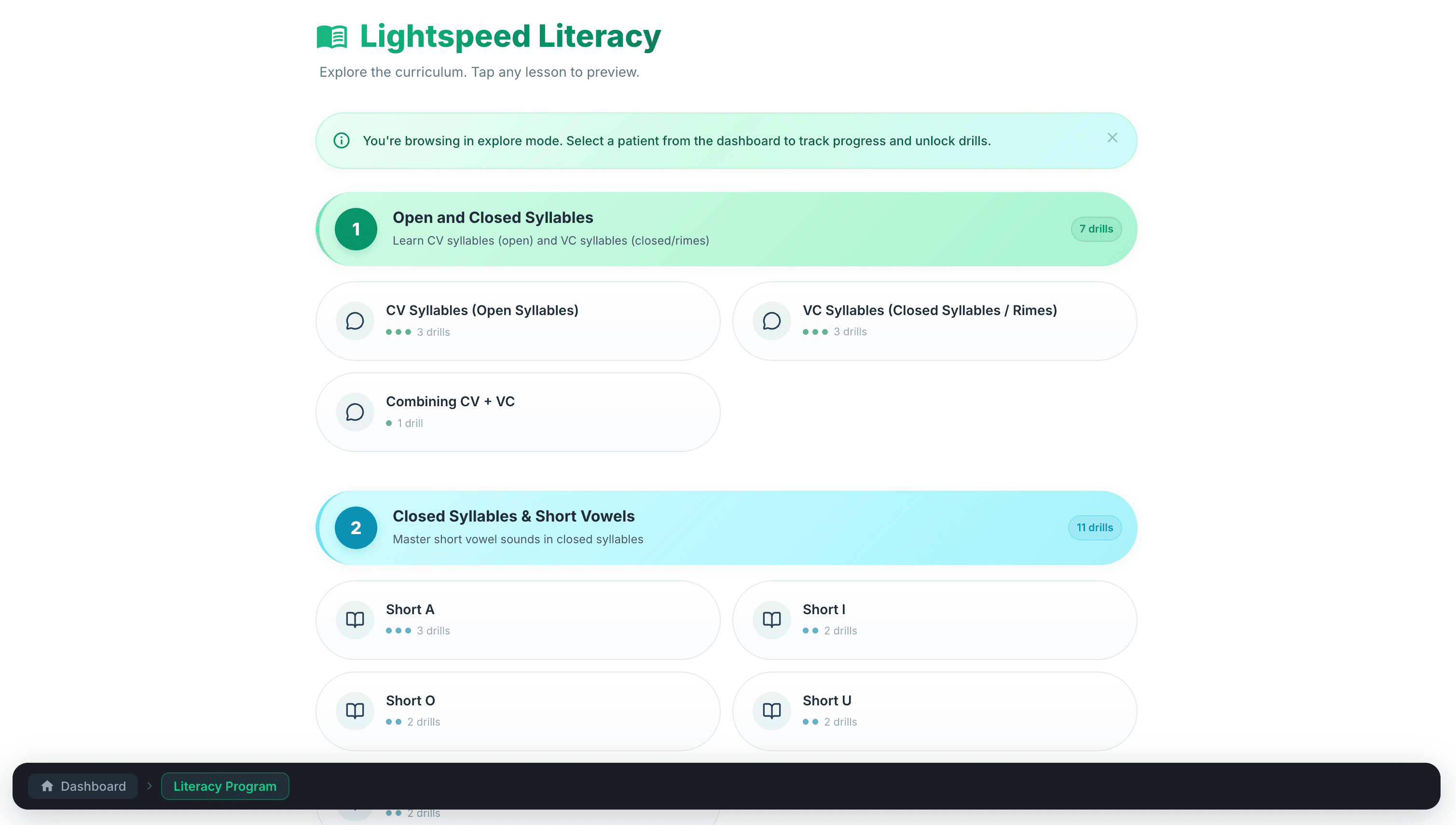
Orton‑Gillingham informed practice with data.
Run practice informed by OG principles and track results alongside the student’s other EASI work.
Therapy materials
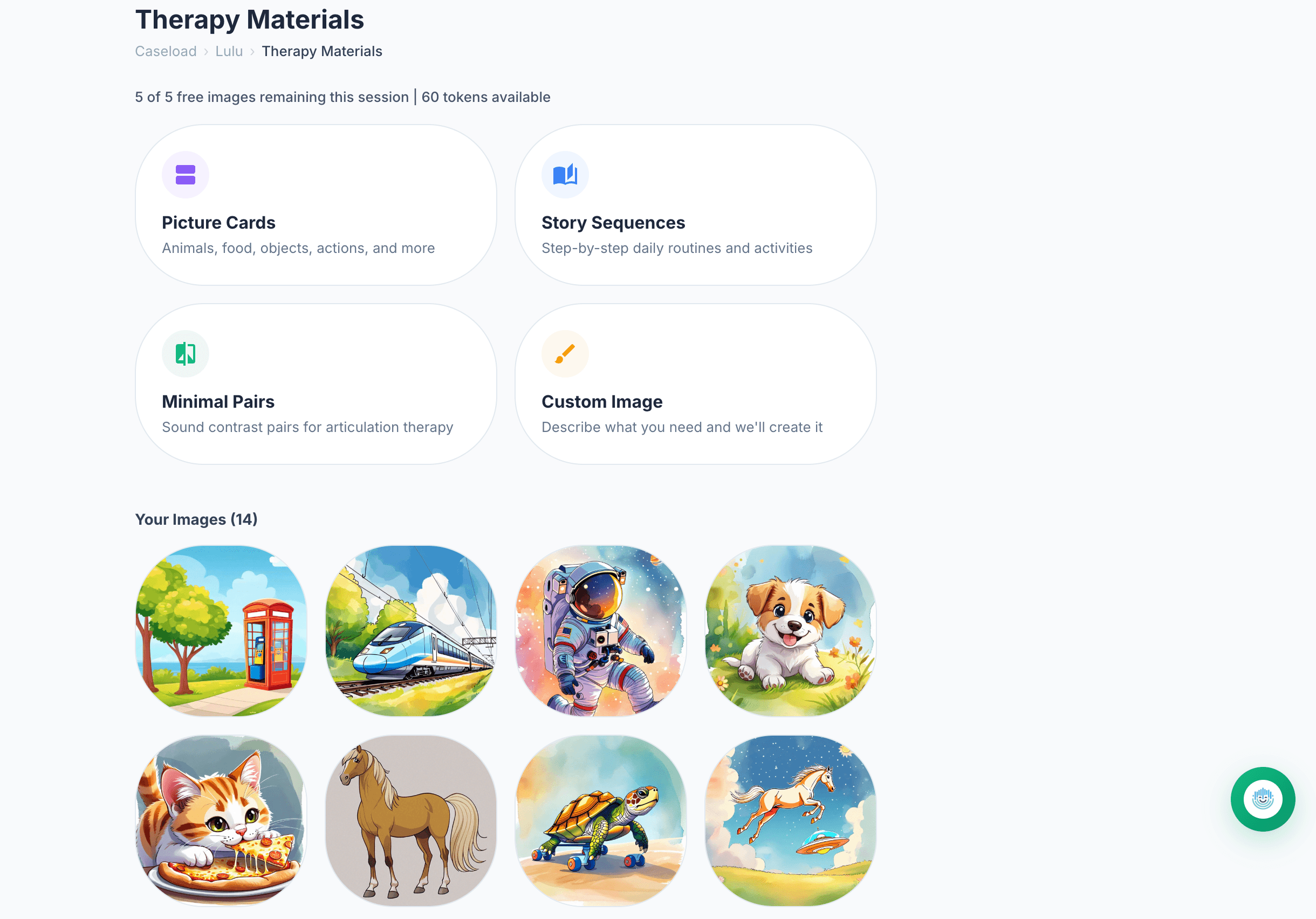
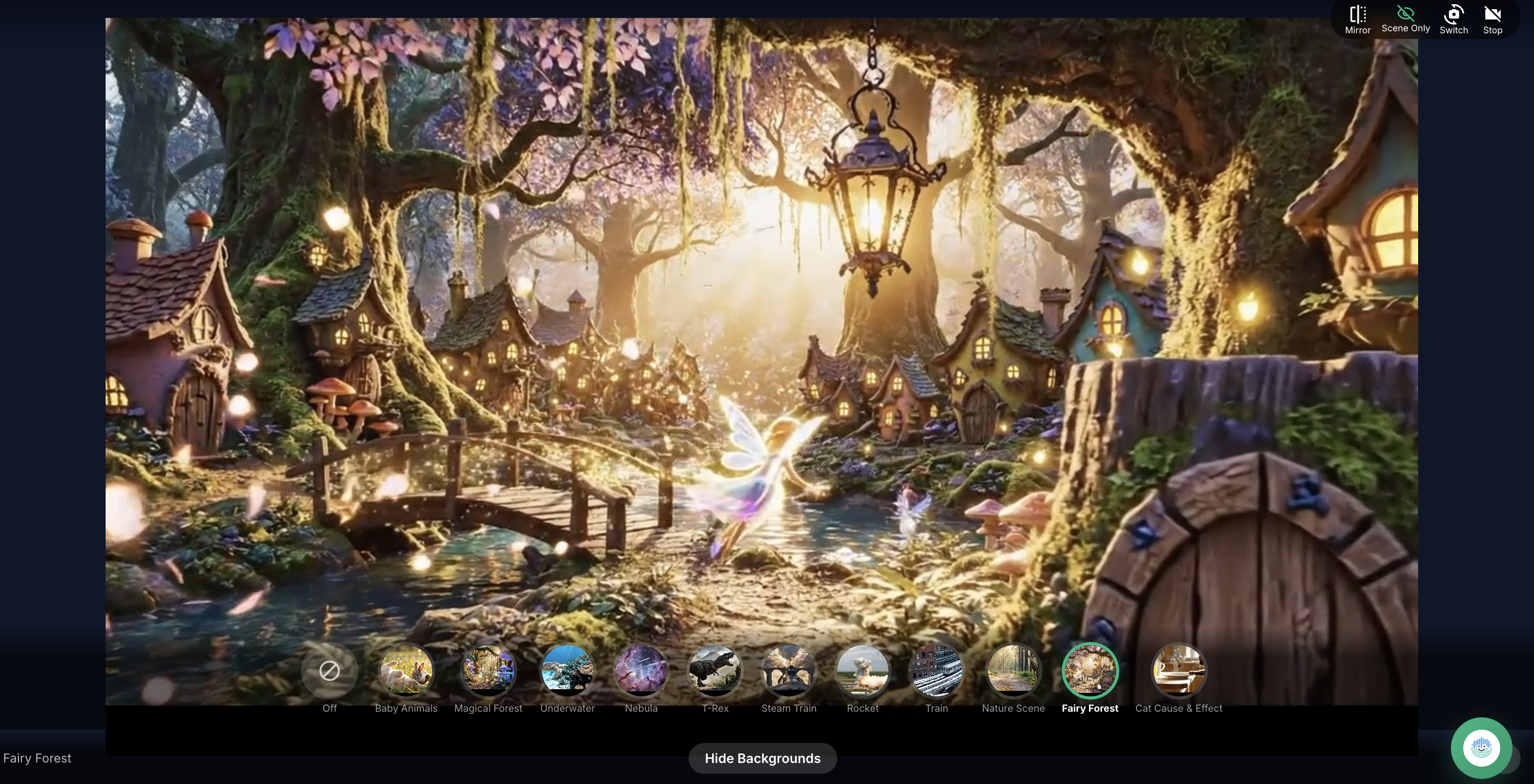
Custom images, core boards, home handouts, and a therapy camera.
Prepare visuals and printable resources. Use scene backgrounds to elicit language during therapy and capture ideas for later documentation.
Template reports
Upload your clinic or district template. EASI fills; the SLP approves.
Bring your actual report form. EASI drafts the sections from the case; the clinician reviews, edits, and approves before export. This is the honest workflow demonstrated live—not a magic one‑click promise.
Clear individual pricing
$39/month, or annual through Northern Speech.
Both individual plans include MySLP. Annual access includes more report capacity; group pricing is available for organizations with 10 or more users.
Monthly individual access
$39/month
MySLP plus 4 report tokens.
Get EASI at Northern SpeechAnnual individual access
$199/year
MySLP plus 50 report tokens.
Get EASI at Northern SpeechDistricts, clinics, and teams
Volume licensing for 10+ users
Contact us for flexible group or district pricing, security documentation, and onboarding.
Request organization pricingPricing verified with Northern Speech Services on August 6, 2026. Confirm current terms before purchase.
Exclusive Partner
Distributed Exclusively Through Northern Speech Services
Your Trusted Partner for 50 Years
Northern Speech Services has been serving the SLP community for five decades, bringing you proven solutions and innovations. EASI represents the next evolution in assessment technology, available exclusively through your trusted partner.
Established reputation in the SLP community
Proven track record of supporting clinicians
Dedicated support team who understands your needs
Commitment to advancing the profession
Questions SLPs ask first
Direct answers about accuracy, clinical control, pricing, privacy, and fit.
Pricing & Access
Individual access is currently $39 for one month with MySLP and 4 report tokens, or $199 for one year with MySLP and 50 report tokens. Additional report-token packages are available, and organizations of 10 or more can request group pricing. These details were verified with Northern Speech Services on August 6, 2026; confirm current pricing and terms on the purchase page before ordering.
Individual EASI access is purchased through Northern Speech Services, EASI’s distribution partner. The pricing page and purchase buttons on this site take you to the current Northern Speech product listing. School districts, clinics, and staffing organizations can use the EASI contact form to discuss group pricing, procurement documents, agreements, onboarding, and deployment needs before placing an organization order.
No. EASI is available for purchase, while individual features may continue to evolve as the team improves the platform. The public website describes the workflows currently offered and avoids promising unverified capabilities. If a particular feature, file type, integration, or organization requirement is essential to your decision, contact the EASI team for current availability and fit before purchasing or planning a deployment.
Clinical Control & Transcript Review
No. EASI organizes evidence, calculates supported measures from clinician-reviewed information, and prepares drafts or suggestions. You stay in charge. The SLP reviews source material, corrects transcripts, interprets results, determines diagnosis and eligibility, chooses goals and recommendations, edits documentation, and approves or signs the final record. EASI is designed to reduce repeated administrative work without transferring clinical decisions to software.
Automatic transcription is a draft, not verified clinical evidence. Accuracy varies with audio quality, speakers, noise, speech characteristics, and language. EASI uses a Draft → Review → Attest → Score workflow so the clinician can correct words, speaker labels, and IPA details before analysis. If a transcript, metric, interpretation, or draft looks wrong, do not attest or finalize it; correct the source, rerun the step when appropriate, and use clinical judgment.
MLU should be calculated from the clinician-reviewed, attested transcript—not silently from an unreviewed machine draft. EASI first produces a draft that the SLP can edit, then requires review and attestation before transcript-derived measures are treated as ready for scoring. Because word boundaries, morphemes, speaker turns, and transcription choices affect MLU, the clinician should inspect the underlying sample and confirm that the analysis is appropriate.
The clinician reviews and corrects morpheme representation before relying on transcript-derived measures. Automatic transcription can miss, substitute, or mis-segment small grammatical forms, especially in noisy recordings or atypical speech. EASI’s review workflow lets the SLP edit the transcript and related details before attestation and scoring. The clinician remains responsible for deciding whether an omission reflects the speaker’s production, a transcription error, or a sample that needs more evidence.
Workflow, Analysis & Languages
Yes. EASI supports organization-specific report templates so reviewed findings, scores, and relevant patient or student context can be drafted into the structure your clinic or district expects. Context may include age, languages, history, diagnoses, goals, prior evaluations, IEPs, or selected records. The clinician reviews the rendered report, edits every clinical interpretation and recommendation, and approves the final document before it becomes part of the record.
EASI supports language-sample and speech measures such as MLU, IPSYN, vocabulary diversity, PCC, intelligibility, phonological information, and related metrics when the workflow and available data support them. A metric is not a diagnosis or a complete evaluation. The SLP reviews the transcript, sample adequacy, elicitation context, applicable norms, linguistic background, other assessment evidence, and the meaning of each result before using it clinically.
Yes. You can upload an existing audio recording instead of recording the interaction live in EASI. You can also type or paste a hand-prepared transcript, import supported transcript files, or bring in a conversation transcript exported from InnerVoice. Audio quality and format can affect processing, and every generated transcript remains a draft for clinician review, correction, and attestation before transcript-derived analysis.
EASI can retain relevant language background and selected contextual records, but the SLP must determine whether a workflow, transcript, metric, comparison, or interpretation is appropriate for the languages and speaker involved. Automated transcription and norms do not remove the need for linguistically responsive assessment. Review the transcript carefully, use qualified interpreters or language-specific resources when appropriate, and avoid treating an English-based metric as complete evidence of a multilingual person’s abilities.
Privacy & Product Comparisons
Yes. iTherapy makes a Business Associate Agreement and security documentation available for organizations evaluating HIPAA-regulated use. Public materials describe encryption, authentication controls, audit logging, incident response, and data-lifecycle controls. HIPAA compliance still depends on the agreement, configuration, users, data, intended workflow, and each organization’s own practices. Privacy, legal, and procurement teams should review the current documents before deployment.
Yes. School districts can request student-data privacy, security, and procurement documentation for FERPA and state-specific NDPA review. Requirements vary by jurisdiction and organization, so a website statement cannot determine compliance for a particular deployment. District privacy, legal, technology, and special-education teams should evaluate the current agreement, configuration, data handling, retention, and intended use against their own policies before approving EASI.
EASI keeps review and approval points inside the work itself. The SLP corrects and attests transcripts before transcript-derived scoring, selects which profile records and supporting documents may inform a report, interprets measures, edits every clinical statement, chooses progress designations, and approves or signs final documentation. EASI connects those safeguards across analysis, reports, notes, planning, materials, and scheduling instead of treating generated text as a finished clinical record.
SALT is dedicated language-sample software with transcription, analysis, standard reports, and comparison databases. EASI includes clinician-reviewed language-sample analysis but is designed around a broader connected caseload workflow: recordings, supporting context, clinic or district report templates, progress documentation, therapy notes, MySLP planning and materials, and scheduling. The right choice depends on your setting, analysis needs, preferred workflow, comparison data, procurement requirements, and the clinician’s review process.
SLP Toolkit focuses on progress monitoring, data collection, and tools for day‑to‑day therapy documentation. EASI includes those downstream uses of evidence but also centers the evaluation workflow: capturing or uploading a language sample, clinician transcript review before transcript‑based scoring, and generating district‑template reports the SLP edits and approves. Many clinicians use SLP Toolkit and EASI together for complementary parts of the workload.
ConductSpeech emphasizes conversation‑based language‑sample analysis and report support. EASI includes clinician‑reviewed language‑sample analysis but connects it to a wider caseload system: reports in organization templates, goal progress, therapy planning, materials, notes, literacy, MySLP, and scheduling. In EASI, transcript‑derived measures are calculated after the SLP reviews and attests the transcript rather than from an unverified machine draft.

EASI Agent
Ask me anything about EASI
No patient data

Hi! I'm the EASI Agent. I can answer product questions about EASI, MySLP, pricing, security documentation, and the full SLP workflow. Please don't enter patient or student information here. What would you like to know?